
Photograph Leh, the Nubra Valley and Zanskar monastery festival
Ladakh is often referred to as Little Tibet, as the religion, landscapes and culture more resemble its Northern neighbour than anywhere else in India. This is a land of mountain peaks, fluttering prayer flags, chanting monks and ancient Buddhist Monasteries.
We have run tours to Ladakh on a number of occasions, taking in a number of different festivals and routes, but really believe that we have our best itinerary ever. We have made a couple of small tweaks from the last time we ran it - including the stunning Pangong Lake and using the new route from Leh to Zanskar, which will avoid two long days of driving. Most notably though, we now finish in the entrancing hillstation of Dharamashala - the home of the Dalai Lama and one of the closest reliable airports, without having to double back all the way to Leh.
This incredible itinerary will show you the very best of this most stunning and unique regions of India. It will also include extensive photography support from professional travel photographer, Steve Davey, countless photo opportunities and the company of fellow photography enthusiasts.
We start our adventure in the Indian capital of Delhi, where we will catch an early morning flight up to Leh, the capital of the Union Territory of Ladakh. This high altitude plateau lies between the Himalayan and Karakoram mountain ranges, and is mostly above 3000 metres.
After time to explore the eclectic town of Leh and acclimatise to the altitude, we will head out to attend the Ladakh Polo festival. This annual event features cultural displays, but tee main attraction is the intense sport of polo, played by teams from all over India.
After another night to acclimatise, we will embark on an adventurous mission over the mighty 5602 metre Khardung La – one of the highest motarable passes in the World – to the remote Nubra Valley.
We will have a few days to explore the valley, where we will visit ancient monasteries and see Bactrian Camels walking over sand dunes, before taking an atmospheric drive to the town of Turtuk near the Pakistan, where you can meet people from the Balti culture.
Our exploration of the Nubra Valley continues with an adventurous drive to the remote Pangong Lake, calling in at two more monasteries on our way.
Pangong Lake is a breathtaking 134 km long, high-altitude brackish lake situated at 4,225 metres, which spans both Ladakh and Tibet. It is famous for its crystal-clear water that appears to change colour.
We leave the Nubra Valley, driving to Thiksey in the Leh Valley. If time permits, we will call in at the ancient and atmospheric Takthok cave gompa, which dates back to the 16th century and is the only monastery dedicated to the Nying-ma-pa or Red Hat sect.
We will arrive back in Leh, where we will have time to further explore the Leh Valley. This will include heading to Thiksey, to witness the morning ritual of blowing a conch shell at sunrise to summon monks to morning prayers at the Thiksey Gompa.
We will also visit the historic Shey and Hemis Gompas, before returning to Leh where we can enjoy a night out, before the next phase of our expedition.
We begin our journey with a long but atmospheric drive to Lamayuru, visiting the historic Likir Gompa along the way. This picturesque monastery is set amongst rugged mountains and is home to an 8 metre gold covered Buddha Statue.
We will also stop at the Alchi Monastery, which dates back to the 11th century and is covered in ancient wall paintings.
Lamayuru is a large Monastery, perched on a high ridge and overlooking a bizarrely atmospheric barren landscape known locally as Moonland. We will have time to explore the monastery, and also the surrounding local village.
From Lamayuru, we will drive the new road which now links the Srinagar-Leh Highway to the remote Zanskar Valley. This atmospheric outpost will be our home for a couple of nights as we explore some of the ancient Monasteries and attend the Stongde Gustor festival.
This traditional festival brings local pilgrims from all over the area to witness religious masked dancing and chanting in the Prayer Hall. It is an entrancing celebration in a picturesque hilltop monastery which dates back almost a thousand years.
Today we will leave Ladakh on a long and atmospheric drive, through stunning scenery. We will leave the Zanskar Valley and head down another new road to Manali in Himachal Pradesh.
Along the way, we will see picturesque valleys and rivers and cross the 5000 metre Shingo La pass. We will also drive through the relatively new Atal Tunnel, which passes under the Rohtang Pass. This is the longest tunnel in the World over an altitude of 10,000 ft. The previous alternative was to drive over the Rohtang Pass - which has taken me over 8 hours in the pre-tunnel days.
We arrive at the alpine town of Manali, and will have some time to explore the Old Town and many temples of this fascinating town, which is surrounded by dense coniferous forests.
Our final stop on this tour will be a scenic drive to the hillstation of Dharamshala, which is famously the home of the Dalai Lama in exile in India. Predictably there are many Tibetan refugees and monks in this town, and it is a relaxing place to spend a few days at the end of our adventure.
This tour is currently being finalised, and we will be posting the dates, prices and full itinerary soon. In the meantime you can see a gallery of images from the last time we ran the trip, and express an interest below.


Why I think our Ladakh photography tour is unmissable
Ladakh truly is unlike anywhere else in the whole of India. Occupying the highest plateau in the country; it is framed by the Karakoram Range to the north and the mighty Himalayas to the south.
Tibetan Buddhism runs through Ladakh: influencing both the religion and the culture and cuisine. Ladakh was formed out of the Ancient Tibetan empire and lasted as an Independent Kingdom for 900 years before it fell to Sikh forces in 1834, later becoming a part of India.
There is an evocative darkness to Tibetan Buddhism which is truly captivating. Monasteries are often painted in a dark crimson: sometimes even black. Prayer Halls generally have no windows, and are dark and atmospheric – often steeped in the heady and overpowering aroma of yak butter and incense. There are demons here too: fearsome faced guardians tower over pilgrims; scaring evil spirits to protect the monastery and reminding people of their own inner demons.
The atmosphere is even more intense during prayers, when dozens of monks will chant in unison, to the accompaniment of horns, drums and cymbals – fuelled only by copious cups of yak milk tea.
For all of its history, Ladakh is changing. The region used to be cut off by road for most of the year due to snow on high passes, now new roads and tunnels under passes are not only making Winter access possible, they are making Summer access easier. Ladakh, and especially Lake Pangong regularly features in Bollywood films, prompting a rush of domestic tourism. Work is soon commencing on a an airport in the Nubra Valley, making a lot more of the region accessible. Now really is the time to go to Ladakh, before it changes even more.
Although there is a unique Ladakhi culture; in many ways this high altitude former kingdom is arguably now more Tibetan than Tibet, and travel here is far more satisfying and traditional than modern day Tibet.
The light in Ladakh is as breathtaking as the altitude. The mountain air has a clarity that you simply don’t see at lower levels. It can be harsh though: we will be almost 4 kilometres closer to the sun, and there is a lot more UV around.
The landscapes are dramatic and unworldy: frozen in the Winter and baked with the heat of the Sun in the Summer, much of the land is harsh and barren but with a backdrop of snow capped Mountains. Mountain Glaciers give rise to great rivers, which over aeons have carved out deep valleys. The Indus, which spawned a civilisation cuts through the regions, and then joins the mighty Zanskar River.
On this itinerary, we will undertake a number of iconic drives, and cross high mountain passes. These will include the snow-capped Khardungla, which is one of the highest motorable passes in the world, the Srinagar - Leh Highway, and a part of the Leh - Manali Highway on our way from Zanskar to Manali.
As night falls, Ladakh turns into an astrophotographer's paradise, offering pristine, light-pollution-free skies where the glowing arc of the Milky Way spans clearly over ancient stupas. We can spend some of our evenings photographing the night sky – shooting star trails and even the Milky Way.
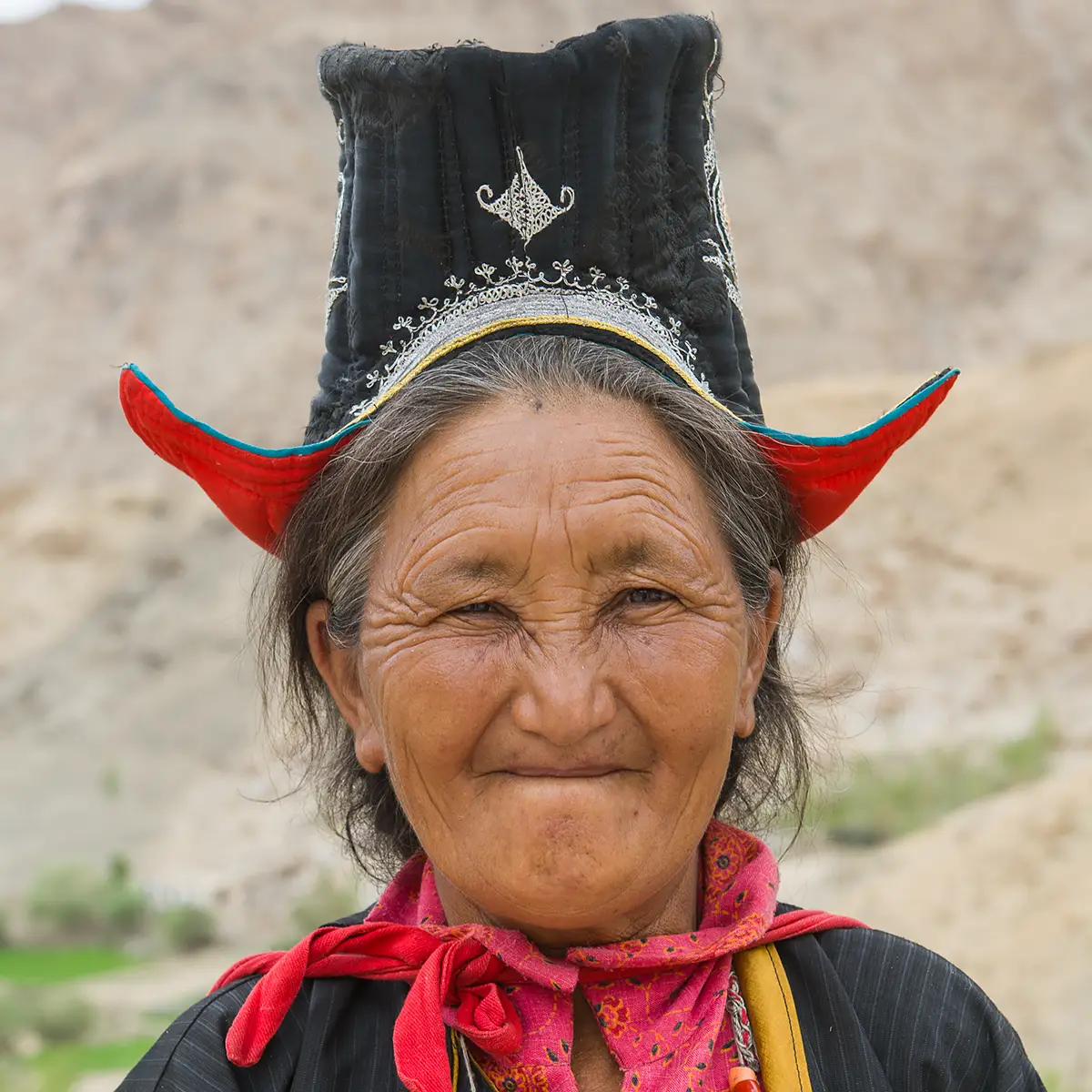
The harshness of the environment is baked into the faces of the people. Every day we will be able to photograph many great atmospheric portraits; with people who are friendly, welcoming and intrigued to see us. It is a place to experience as much as much as photograph, and the engagements and memories of the people will last as long as the photographs.
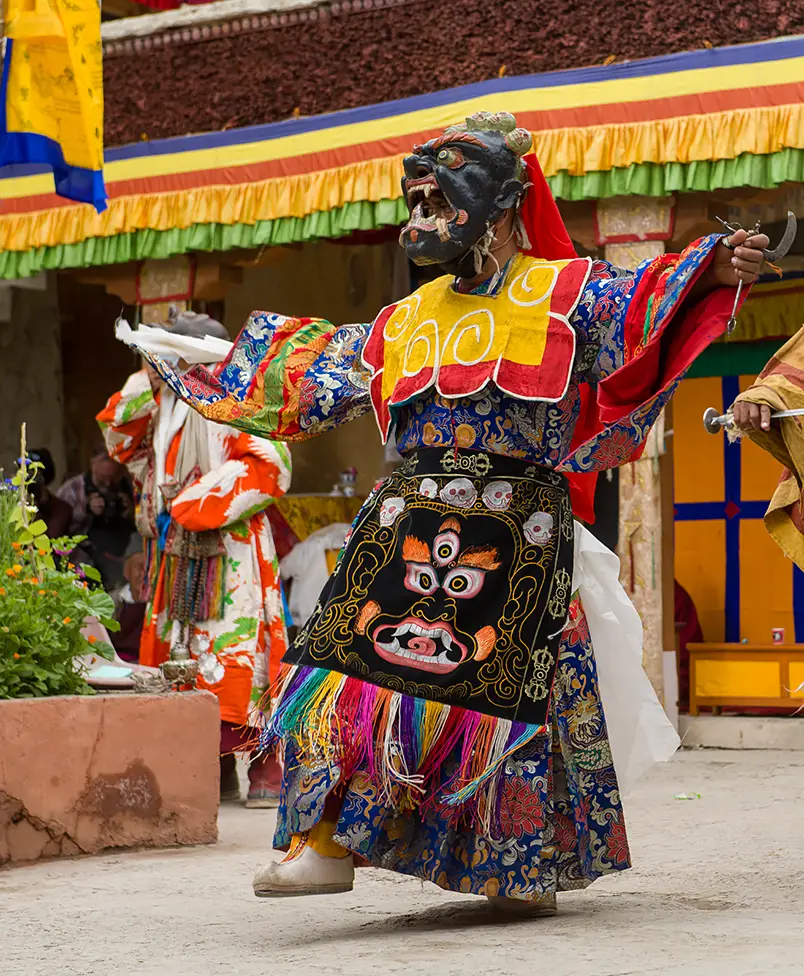
Ladakh is a land of festivals. Each of the seemingly countless monasteries will hold their own Gustor, or festival, which will feature the traditional masked Cham Dancing. Hypnotisingly repetitive, Cham dancing tells stories of the triumph of good over evil, the teachings of Tibetan Buddhism, and historical events from the region.
The most spectacular and emotional dance is the Back Hat Dance, which tells a pivotal historical story from 841 CE of the killing of the apostate King Langdarma – a ruthless ruler who violently persecuted and attempted to eradicate Buddhism in Tibet, and was assassinated by a Buddhist monk. As this dance is performed, the atmosphere builds and the spectators get carried away by the intensity of the story.
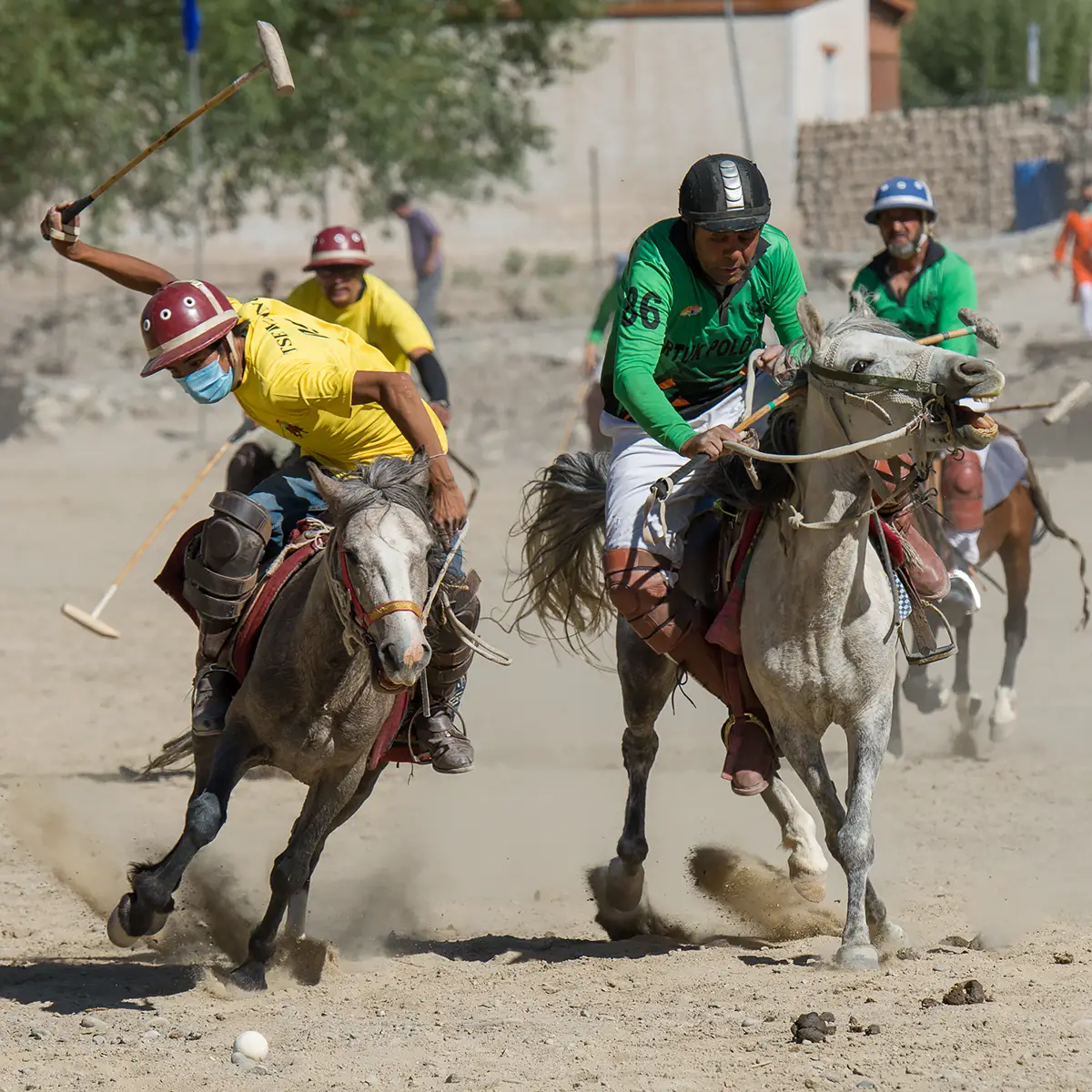
Not all of the festivals are ancient or religious: we will also attend the Ladakh Polo Festival and watch one of the frenetic and iconic matches. Ladakh polo is unique in that there are six horses per team, and this lively festival blends sport with culture; and lots of great local food.
I hope that you decide to join me on this unique photographic expedition through one of the most remote, yet culturally rich places on the planet.
Steve Davey
Photography opportunities
There are a many atmospheric and photogenic experiences that you will that you will be able to enjoy and photograph on this trip. Our unique itinerary will give you as many real, and organic photo-opportunities as we can cover on our time away. We are also able to include pretty much anything that you find interesting as drive along: whether it is a breathtaking landscape or a local yak herder.
Some of the unique photo opportunities you can enjoy on this trip include:
- Jama Masijd, Old Delhi - Mughal era Mosque in the old town
- Chandi Chowk, Old Delhi - Busy bazaar street and spice market
- India Gate, New Delhi - Imperial city designed by Luteyns
- Old Town, Leh - Atmospheric alleyways of Old Leh
- Shanti Stupa, Leh - Bright white peace pagoda overlooking Leh
- Views across Leh - Sunset views from Shanti Stupa
- Leh Palace, Leh - Multi-storied palace modelled on Potala in Lhasa
- Ladakh Polo Festival - Traditional culutral display and local portraits
- Ladakh Polo Festival - Fast action traditional polo match
- Khardungla - 5602 metre, snow capped pass leading to Nubra Valley
- Nubra Dunes - Sand dunes and Bactrian Camels
- Diskit Gompa, Nubra - Ancient monastery with giant Buddha
- Shyok River Valley - Rugged road leading to Turtuk
- Turtuk village, Nubra - Remote village with fruit trees & Balti culture
- Samstanling Gompa, Samur - Colourful monastery in village
- Pangong Lake - High altitude lake at sunrise & sunset
- Taktok Gompa, Sakti - Historic and atmospheric cave temple
- Shey Palace, Shey - Ruins of Palace on a hill above the monastery
- Shey Gompa, Shey - Historic Gompa
- Thiksey Gompa, Thiksey - Morning Conch Shell ceremony
- Thiksey Gompa, Thiksey - Historic Gompa with tremendous views
- Hemis Gompa, Hemis - Stunning large monastery with courtyard
- Hemis - Mountain views across the valley
- Sangam Point, Nimmu - Confluence of emerald-green Indus River and muddy-blue Zanskar River
- Likir Gompa, Likir - Monastery and snow-capped peaks
- Likir Gompa, Likir - Giant seated golden Buddha
- Alchi Gompa, Alchi - Ancient monastery exteriors and prayer wheels
- Lamayuru - Incredible Moonland landscape
- Lamayuru - Historic gompa and carved mani stones
- Lumayuru - Sunrise and sunset over village and gompa
- Stongde Gustor, Zanskar - Cham dances in courtyard
- Stongde Gustor, Zanskar - Pilgrims, yak and chanting monks
- Sani Gompa, Zanskar - Unique gompa in the area
- Zangla Palace, Zanskar - Ruins of ancient palace
- Dzongkhul Monastery, Zanskar - Monastery built into cliff face
- Karsha Gompa, Zanskar - Fortress-like monastery on craggy slope
- NPD Road - Incredible views including of turquiose Tsarap River
- Shinku-La - Snow capped pass with fluttering prayer flags
- Old Manali, Manali - Historic district of ancient wooden buildings
- Hidimba Devi Temple, Manali - Historic wooden temple in forest
- Guru Vashisht Temple, Manali - Temple, ashram and hotsprings
- Dharamshala - Views of Dhauladhar Range
- Norbulingka Institute, Dharamshala - Tibetan handicrafts
- Dalai Lama Temple, Dharamshala - Tibetan pilgrims and prayer wheels
On this unique trip we will be accompanied throughout by Chetan: Intrepid's best leader in India. I have worked with Chetan for over 20 years and between us we have unparalleled experience in finding and creating photo-opportunities, and in getting permission to photograph in places which are otherwise not allowed.
Impressions of Ladakh festival photography tour - full details
Below you can find all of the details about Steve Davey, who has organised and will be leading this festival photo tour of Ladakh, Intrepid Travel, who will be handling the land arrangements and bookings, as well as the full price information, dates and what is included in the trip price; and the full itinerary.
Impressions of Ladakh
11 to 27 July 2027
Places left: 12
*Includes held places
Min 7, max 12 people
Variable price from:
7 pax £3550 pp
8 pax £3450 pp
9 pax £3350 pp
10 pax £3250 pp
11 pax £3150 pp
12 pax £3050 pp
excl. flights, based on roomshare
Price is variable depending on the number of people booked on the trip. You should be prepared to pay the 8 person price; refunds will be processed once the final numbers are confirmed.
Optional single supplement: £500
Although you can opt for a roomshare place, and we will do our best to find someone for you to share with, if this is not possible and you have to have a room to yourself, then unfortunately the single supplement will be payable.
Included in the trip price
- 14 nights hotel accommodation
- 2 nights camp accommodation
- 16 breakfasts
- 12 dinners
- Group arrival transfer
- Group departure transfer
- Flight from Delhi to Leh
- Leh – Polo Festival
- Leh – Shanti Stupa
- Nubra – Turtuk visit
- Nubra – Diskit Gompa
- Nubra – Samstanling Gompa
- Sakti village - Taktok Gompa
- Leh - Leh Palace visit
- Shey – Shey Gompa
- Thiksey – Thiksey Gompa
- Hemis – Hemis Gompa
- Likir – Likir Gompa
- Alchi – Alchi Monastery complex
- Lamayuru – Lamayuru Monastery
- Zanskar – Sani Gompa
- Zanskar – Zangla Palace
- Zanskar – Stongde Gustor festival
- Zanskar – Dzongkhul Gompa
- Zanskar – Karsha Monastery complex
- Manali – Hidimba Devi Temple
- Manali – Walking Tour of City
- Dharamshala – Norbulingka Institute
- Dharamshala – Dalai Lama Temple
- Group departure transfer
- All transport as per itinerary
- English Speaking leader
- Entrance fees as per itinerary
- Expert photographic support
Not included in the trip price
The following things are not included in the trip price:
- International Flights
- Any visas required
- Services not mentioned in the itinerary
- Late check out at hotels
- Meals/drinks not mentioned in the itinerary
- Drinks with included lunches and dinners
- Tips for leaders, guides and drivers
- Expenditure of personal nature
- Personal Insurance
- Optional activities
Although international flights aren't included in the trip price, you can opt to have Intrepid Travel buy these for you which gives you a greater level of industry protection, and if your journey starts and finishes in the UK the trip can be covered by an ATOL certificate.
Ladakh Festival Photo Tour – Full Tour Itinerary
The full itinerary of our festival travel photography tour to Ladakh, including the Nubra and Zanskar Valleys, the Stongdey Gustor and Leh Polo Festivals and atmospheric Dharamasala, with land arrangements and comprehensive travel industry ATOL protection by Intrepid Travel; led by professional photographer, Steve Davey.
Nameste! Welcome to India! Our adventure begins in Delhi, where we will be picked up from the airport and transferred to your hotel (group flight only). Standard Check in time at the hotel 14:00 hours.
Delhi is a fascinating city, and if you haven't visited before, then we do urge you to try to spend an extra day or two here before the start of the trip. Loosely comprising of Old Delhi and New Delhi; both have some incredible monuments to see, and their own unique atmosphere.
Old Delhi is noted for the ancient Red Fort, or Lal Qila, which was commissioned by the Mughal Emperor Shah Jahan 1639 and the Jama Masijd mosque which built a few years later. Around the Jama Masijd is a network of historic alleys, and the incredibly busy Chandni Chowk – one of the oldest and most historic wholesale street markets of Old Delhi that dates back to1650.
At the 1911 Delhi Durbar, King George V announced that the capital of India was to move from Calcutta to Delhi. Inaugurated in 1931, the ambitious work of British architects Sir Edwin Lutyens and Herbert Baker, New Delhi is an audacious statement of Imperial British control over India. Monuments here include the India Gate, and the Raj Path which leads to the Indian Parliament building.
Special Information
This evening at 18:00 meet with our tour leader at hotel for the briefing of a trip followed by a welcome dinner at local restaurant. It’s very important that you attend the welcome meeting as we will be collecting insurance and emergency contact details at this time. If you are going to be late, please let us or hotel reception know. Ask reception or look for a note in the lobby for more information on where the meeting will take place.
Arrival transfer:
Included on Group flight basis only
Accommodation: Jaypee Siddharth Hotel or similar
Meals included: Welcome dinner
After breakfast, we will be transferred to the airport to board our flight to Leh to experience this Himalayan region of high mountain passes, monasteries, stupas, breathtaking landscapes, and local festivals. We are planning to take Indigo 6E-2583 (11:05 hours – 12:25 hours)
Upon arrival in Leh, we will be met with our representative and transferred to the hotel. The day is at leisure to get acclimatised to the high altitude. Situated at high altitude above 3524 metres it is important to get used to the altitude for the next few days to avoid AMS (Acute Mountain Sickness).
There is a lot to see in Leh and we will have time to explore further later on the trip. Today though, maybe enjoy a gentle stroll to the centre of town, to browse some of the many shop, look inside some of the historic monasteries, and soak up the atmosphere of this unique town. Later in the evening we will head out for dinner.
Special Information: Snacks and Soft Beverages are available for sale onboard the flight. Flight timings and fares are subject to change at the time of issuance of tickets. Domestic Baggage Limit is 15 kgs checked baggage and 7 Kgs hand baggage. Obviously you may well have more baggage, but this is relatively cheap at 800INR (approx. £6.25 a kilo) – less if you buy it in advance.
Included activities:
• Delhi to Leh flight
Accommodation: Hotel Leh Plaza or similar
Meals included: Breakfast & Dinner
Today we will head to the week long Ladakh Polo festival. Polo is a heritage game of the Ladakhi region, and seeing the spirited competitions against a backdrop of majestic and picturesque Himalayan mountains is breathtaking.
The unique thing about Polo in Ladakh is, that it is different from that played all over the world, as it features six (not four) players per team, local mountain ponies and is played on rugged natural terrain – sometimes accompanied by traditional live music. This game was introduced to Ladakh in 15th century CE through a princess from Baltistan, who also happened to be a mother of the Ladakhi ruler, Singge Namgyal.
The festival should also have cultural dancing and maybe even an archery display – to showcase Ladakhi culture. The festival also is a great place to sample local cuisine like Thukpa (soup noodles), Mok mok (dimsum), chutai-sku (local pasta) and kholak (barley), and to interact with local people who come along to witness the event – often dressed in traditional clothes.
After our time at the Polo Festival, we will visit the Shanti Stupa – a beautiful white domed stupa on a hilltop in Chanspa, built by a Japanese Buddhist as a part of Peace Pagoda mission. The Shanti Stupa has fantastic views across Leh, and the light is perfect as the sun begins to set. After dark we will be able to see the illuminated Stupa which looks unique and beautiful during evening hours.
Included activities:
• Leh - Polo Festival visit
• Leh - Shanti Stupa visit
Accommodation: Hotel Leh Plaza or similar
Meals included: Breakfast & Dinner
After breakfast we will take the very scenic and classic drive to Nubra Valley via Khardungla, one of the highest motorable roads in the world, at approximately 5602 metres. Along the way we will take short breaks at roadside cafes and scenic points for photography.
Even though July is the hot season in Delhi, with temperatures reaching up to 30° centigrade, there is usually snow at the top of Khardungla, which attracts many domestic tourists who like to indulge in snowball fights. There is also a small temple bedecked many colourful prayer flags at the pass and a strong Indian army presence. The road is maintained by the Border Roads Organisation, a part of the Indian military and we are very likely to see road maintenance happening, which is done with atmospherically very little health and safety.
The Border Roads Organisation is also responsible for the iconic yellow safety signs such as "Life is Short – Don't Make it Shorter", which you will see by the sides of roads all over Ladakh.
After exploring Khardungla, we continue our scenic drive to Nubra Valley, stopping on route for various photo-opportunities, such as nomadic Yak herders and a reflective lake.
Nubra valley originally called Ldumra, which means valley of flowers, is famous for its stark landscape, rough mountains and Bacterian Camels. The Shyok and Siachen Rivers meet in the Nubra valley, and this is the place that separates Ladakh from the Karakoram range and the massive Siachen glacier.
Upon arrival by mid-afternoon, check in at our camp. Later in the afternoon we will head to the Nubra dunes to photograph the dunes and Bactrian Camels at sunset, before returning to our camp for dinner.
Special Information: Leh to Khardungla is approximately 80 minutes drive (40 kms); Khardungla to Nubra Valley is approximately 3 hours drive (82 kms).
Included activities:
• Leh - Khardungla pass
Accommodation: Fossils Premier or similar
Meals included: Breakfast & Dinner
Today we will explore and enjoy the landscape and the mesmerising views of this iconic valley by driving to the villages of Turtuk and Tyakshi, through incredible mountain and riverine scenery.
Nestled in the Nubra Valley along the banks of the Shyok River, Turtuk is a breathtaking, lush oasis surrounded by arid Karakoram peaks. As India’s northernmost village, this culturally distinct Balti enclave—replete with apricot orchards and around 300 stone houses—was opened to tourists only in 2010.
Originally part of Baltistan under Pakistani control following the 1947 partition, Turtuk and its surrounding borderlands were thrust into the frontlines of the 1971 Indo-Pakistani War. During the conflict, Indian forces under Operation Ladakh launched a daring campaign, capturing the region and permanently shifting the Line of Control to integrate these villages into India. Along the way, local regimental memorials honour the incredible resilience and sacrifices of soldiers who fought in these treacherous, frozen terrains.
Located just a few kilometres past Turtuk toward the Line of Control, Tyakshi is another serene Balti village that changed sovereignty overnight in 1971. Known for its warm hospitality, terraced fields, and unique blend of Tibetan and Persian heritage, it offers a poignant look at life right on the border edge.
Note: depending on the prevailing political climate, there are times when non-Indian passport holders are not allowed in to Tyakshi; no-one is allowed to approach the Line of Control.
After exploring the Nubra valley during the day, return to our camp by evening. Dinner and overnight stay at camp.
Special Information: Our round trip today will be approximately 5-6 hours drive (170 kms)
Included activities:
• Nubra - Turtuk village visit
• Nubra - Tyakshi village visit
Accommodation: Fossils Premier or similar
Meals included: Breakfast & Dinner
This morning after breakfast we depart from the Nubra valley and drive to Pangong Lake. En route we will visit Diskit Monastery to see the 106 ft Maitreya Buddha statue. This is considered to be the largest and the oldest monastery in Nubra valley, and was founded by Changzen Tserab Zangpo in the 14th century. The Monastery is situated on a hill above the plains of Shayok river, the Maitreya Buddha statue was inaugurated by HH Dalai Lama, and offers a magnificent panoramic view of Nubra Valley.
We will continue on to visit Samstanling Gompa. The remoteness of the Gompa's location adds to the aura and mystique: it can also be seen from a distance, with its gold, red & white hues. Perched in Sumur village, it is a prominent 19th-century Gelugpa monastery founded by Lama Lama Pavu Khenpo. Framed by colorful prayer flags and dramatic mountain backdrops, it houses a rich collection of traditional wall paintings, intricate thangkas, and statues of Buddha and his avatars.
Finally, we continue to Pangong Lake. On arrival by late afternoon, we will settle in our accommodation and enjoy the almost supernatural beauty of the landscape here at the end of the world. We can hike along the lake and will be rewarded with a beautiful view for our efforts.
Pangong Lake straddles the border between Tibet and Ladakh, and part of the shore is a closed military area. The lake lies at 4300 metres altitude, and famously shifts colours throughout the day, displaying brilliant shades of blue, green, and grey depending on the sunlight and weather. The lake serves as an important breeding ground for migratory birds such as bar-headed geese and Brahminy ducks.
Special Information: Our total travel today will be approximately 6 hours drive (240 kms)
Included activities:
• Nubra - Diskit Monastery visit
• Nubra - Samstanling Gompa visit
Accommodation: Pangong Vista Resort or similar
Meals included: Breakfast & Dinner
Early this morning we will get up to experience the mesmerising view of sunrise at Pangong Lake. Then after breakfast we will depart from Pangong and return to Leh, taking a different route to our arrival in Nubra.
Along the way, we will visit the Taktok Gompa. Situated in Sakti village, Taktok Gompa is the only monastery in Ladakh belonging to the Nyingma tradition of Tibetan Buddhism. Its name translates to "rock roof," as the entire monastery is built around a mountain cave where Padmasambhava (Guru Rinpoche) is believed to have meditated in the 8th century. Today, it stands out for its unique cave-dwelling architecture and ancient, soot-darkened murals.
As we continue on our way, we will stop to photograph the stunning Chemrey Gompa. Founded in 1664 as a memorial to King Sengge Namgyal, Chemrey Gompa is a striking 17th-century Drugpa Kagyu monastery perched dramatically on a steep hill in the Indus Valley, famous for its grand statue of Padmasambhava and rare collection of ancient scriptures written in silver and gold lettering.
Upon arrival in Leh we will visit Leh Palace, a nine-storey building depicting medieval Tibetan architecture. The Palace offers amazing view of Stok Kangri and the Ladakh region, the huge walls and the wooden balconies of the palace are modelled on the Potala Palace in Lhasa, capital of Tibet. The former palace of the royal family of Leh, it was erected in the 17th century.
After our visit we have the option of wandering around the local Tibetan market in Leh, to see the local life and the handicrafts of this region. You may shop or spend time walking through the markets. Dinner and overnight stay at hotel.
Special information: Our total travel today will be approximately 4 hours drive (158 kms)
Included activities:
• Sakti - Taktok Gompa
• Leh - Leh Palace
Accommodation: Hotel Leh Plaza or similar
Meals included: Breakfast & Dinner
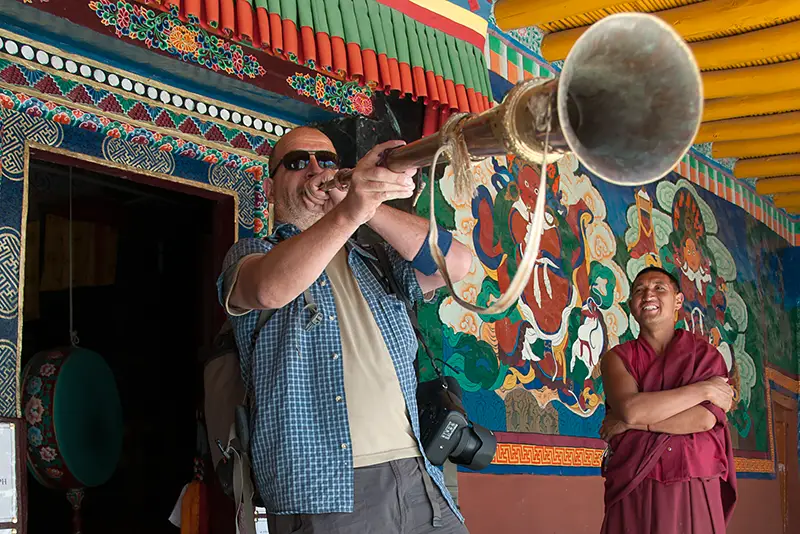
For those who are keen, we will have an optional very early start this morning to drive to nearby Thiksey Monastery to photograph the morning Conch shell ritual which summons monks for morning prayers at sunrise. After which we can stay for the prayers.
Those who have made the early start will find a breakfast locally, and those who have had a lie in will have breakfast at the hotel and then join the rest of the group to look around Shey Gompa.
Shey Monastery was built in 1655 within the Shey palace complex. The palace was the former residence of the pre-Tibetan royal family. The palace houses a 12 metre high copper statue of Lord Buddha which is plated with gold and is the largest of its kind and covers three stories in the building.
We will continue on to visit Thiksey Monastery, which is famous for its architecture and its location. The 12-storey monastery has 10 temples, assembly hall, and residence for 120 monks and nunnery. The monastery buildings are structured in hierarchal order. The monastery is referred as ‘Mini Potala’ of India as it resembles Potala Palace in Lhasa, Tibet.
Later we will drive to Hemis Monastery which is dramatically hidden in a cleft the mountains. Here we find a gigantic thangka, one of the largest in the world, and the largest and one of the most important in Ladakh. Hemis Gompa was founded about 350 years ago by Stagtshang Rinchen, who was invited to Ladakh by King Singe Namgyal.
Please note: photography of the interiors of Hemis monastery and especially the Museum is strictly forbidden. You can see more about photograph restrictions inside of monasteries in Ladakh in the Notes.
Once we have finished in Hemis, we will drive back to Leh for our final night in this intriguing city before exploring the rest of Ladakh.
Included activities:
• Shey – Shey Monastery
• Thiksey – Thiksey Monastery
• Hemis – Hemis Monastery
Accommodation: Hotel Leh Plaza or similar
Meals included: Breakfast & Dinner
After breakfast today you will explore the west side of Ladakh known as the Sham Valley/Lamayuru. Lamayuru is known as the Moonland for its magnificent, out of this world landscapes and beautiful monastery.
Enroute we will stop at Likir Monastery (approximately 68 Kms from Thiksey, 2 Hours’ drive approximately). Likir Monastery was built in the 11th century and was again rebuilt in the 18th century and is home to a 25 feet gold covered seated Buddha Statue.
After that drive further to Alchi village, which is surrounded by snow-capped mountains. This area is incredibly isolated, and it is fascinating to see how the lifestyle of the monks of Alchi Monastery have adapted to the remoteness. The architecture of Alchi Monastery is of Tibetan style. The monastery complex has three major shrines – the Dukhang (Assembly Hall), the Sumtsek, and the Temple of Manjushri. There are also chortens in the complex.
Please note: photography of the interiors of Alchi monastery is strictly forbidden, but the exteriors, lines of prayer wheels and entrancing village life make it well worth the effort. You can see more about photograph restrictions inside of monasteries in Ladakh in the Notes.
After the visit we will continue our drive to Lamayuru via the famous Moonland. Upon arrival check in and have some time to walk around the village, before catching the sunset – the views from just in front of our hotel across the village to the monastery on a large rocky outcrop are perfect. Dinner and overnight stay at hotel.
Special Information: Our travel today will be approximately 3.5 hours drive (128 kms)
Included activities:
• Likir - Likir Monastery
• Alchi - Alchi Monastery
Accommodation: Hotel Grand Moonland or similarMeals included: Breakfast & Dinner
If you are keen, there is an opportunity to climb a nearby hill to view the sunrise over the monastery, but this will take a very early start. An alternative would be to attend the morning chanting at the monastery, although photography is generally not allowed.
After an early breakfast, we breakfast venture out to explore Lamayuru Monastery, a Tibetan Buddhist Monastery which occupies an incredible position on the top of a vast rocky outcrop in the middle of the village. Founded in the 11th century by the Indian scholar Naropa, who legend says miraculously drained a high-altitude lake to build the sanctuary, Lamayuru is one of Ladakh’s oldest and largest Drikung Kagyu monasteries, Nearly 150 monks belong to the monastery and 30-40 still reside at the gompa belonging to the Red-Sect of Buddhism.
Some of the highlights of Lamauyru are the ancient stupas and lines of prayer wheels, which are seemingly littered with more recent mani stones, which are hand-carved with sacred Tibetan Buddhist texts, most commonly the six-syllable mantra "Om Mani Padme Hum". The views from the top of the monastery down to the Moonland landscape are spectacular.
From Lamayuru we will drive to Padum in the Zanskar Valley, along the new road, which was only finished a few years ago. Previously the drive to Zanskar would have taken two or three days via the town of Kargil.
Upon arrival check in at hotel and evening free at leisure. Dinner and overnight stay at hotel.
Special Information: Our travel today will be approximately 7 hours drive (200 kms)
Included activities:
• Lamayuru – Lamayuru Monastery
Accommodation: Hotel Potala or similar
Meals Included: Breakfast & Dinner
For the next two days, we will be exploring the remote Zanskar valley along with the historic Stongdey Gustor festival.
This morning after breakfast, we will drive to Sani Gompa which stands apart from all other gompas in Ladakh as it is not built on a hill or mountain but on flat land. It is built in the shape of a fortress. Located next to Sani village, it is believed to be the oldest religious site in the entire Ladakh and Zanskar region. The gompa belongs to the Drukpa Kagyu school of Tibetan Buddhism and is the only order which has nuns.
We will also visit Zangla Palace, an old castle which is almost in ruins, but is still inhabited by some monks. It is often referred to as a Zangla Monastery, majorly because it houses a temple. The view from the castle is simply spectacular, making it an unmissable site. We will also visit the nearby Tsa Zar monastery.
Later we will drive to Stongdey Monastery to witness this important Ladakhi festival which is famous for its Cham Dances. This is a two day festival that takes place in the 11th month of Tibetan Calendar. Local people from nearby villages come to be a part of this festival. The monastery is decorated beautifully, while the locals beautify themselves in the most traditional attire, the lamas and monks from the monasteries add an extravagant charm to the festival by performing their sacred dance.
In the morning, the monks raise a sacred pillar in the centre of the courtyard, then in the prayer hall monks start their haunting religious chanting.
The festival opens in the afternoon with a grand gathering in the central courtyard as resident monks perform the sacred Cham masked dances, invoking fierce Gelugpa protector deities through synchronised movements to cleanse the land of negative energies. Devotees and villagers from across the Zanskar Valley arrive in elaborate traditional dress, filling the monastery to receive spiritual blessings and watch the colourful, story-driven mythical performances.
Later we will return to Padum for a dinner and overnight stay at hotel.
Included activities:
• Zanskar – Sani Gompa
• Zanskar – Zangla Palace
• Zanskar – Stongdey Gustor Festival
Accommodation: Hotel Potala or similar
Meals Included: Breakfast & Dinner
Today we will visit Dzongkhul Monastery or Zonkul Gompa, about half an hour drive from Padum. This small monastery is located in Stod village, and is famous for its frescoes on the cave wall, a beautiful prayer room, library, glass swastika, collection of paintings on cloth and several statues.
Dating back to the 11th century, this rare cave monastery was founded by the Indian Mahasiddha Naropa, who famously used the natural rock shelters as a secluded retreat for deep meditation. Uniquely carved directly into a sheer cliff face in Zanskar's Stod Valley, the complex features historic cave frescoes created centuries ago alongside sacred rock impressions of Naropa's staff and footprints.
Afterwards we will visit Karsha Gompa, located in Padum valley above the Stod river. As the largest and most prominent Gelugpa monastery in Zanskar, Karsha was established in the 11th century by the famed translator Phagspa Shesrab and remains an active spiritual heartland for over a hundred resident monks. Its vast collection of whitewashed, fortress-like buildings tumbles dramatically down a craggy mountain slope, offering sweeping panoramic views over the Doda River and the Padum Valley below.
It was founded in the 11th century and was constructed on the steep mountain above Karsha village. The monastery is famous for its wall paintings, huge collection of Thangkas (paintings on cotton and silk). The complex has eight temples, chapels, chortens, residential rooms for 150 monks and assembly halls. The 14th Dalai Lama’s younger brother looks after the monastery.
In the afternoon, we can return to the Stongde Gustor for the second day of the festival. The second day builds toward the spiritual climax of the festival with high-energy ritual dances depicting the ultimate victory of good over evil.
As a part of the ceremony, a live, adorned yak is led directly into the central monastery courtyard as a symbolic representation of the local protective deities (Dharmapalas) and mountain spirits. Its presence serves as a living vessel to absorb the accumulated negative energies, bad luck, and evil forces of the community before the final Storma effigy is destroyed and burned to purify the valley for the year ahead.
Included activities:
• Zanskar - Dzongkhul Monastery
• Zanskar - Karsha Monastery
• Zanskar - Stongde Gustor
Accommodation: Hotel Potala or similar
Meals Included: Breakfast & Dinner
The next phase of our journey sees us leave the Zanskar Valley and Ladakh, to head to Manali in Himachal Pradesh. We will be driving along the stunning Nimmu–Padum–Darcha (NPD) road, which was only provisionally finished in March 2024.
For all of the construction, this is still an adventurous option and the views from the road are unparalleled. We will need to leave by 6:30am in order to be able to ford a couple of rivers before the days glacial melt makes them impassable.
Along the way we will make a number of photo-stops, including yaks, the turquoise waters of the Tsarap River and the snow capped summit of the Shinku-La pass, bedecked with prayer flags. This pass is over 5000 metres, and marks the border between Ladakh and Himachal Pradesh. The pass will soon be bypassed with a tunnel which is under construction.
After we enter into Himachal Pradesh, we join the Leh-Manali Highway, which was previously one of only two road routes into Ladakh. This highway passed over the Rhotang Pass, a 4000 metre pass that was closed by snow for most of the year – cutting Ladakh off from the rest of India by road. Now the road passes through the 9 km Atal Tunnel under the Rhotang Pass, which was opened in 2020. Once crossing the pass took me 10 hours. Now the tunnel has reduced this to a matter of minutes, and means that the road to Ladakh is drivable all year.
Reaching Manali is always a relief, and this pleasant alpine town is noted for its atmospheric Old Town, temples and free-growing marijuana plants, which made it popular with hippie travellers in the 1970s.
Although it feels like a thriving metropolis after the remoteness of Ladakh, Manali is still a remote outpost in itself. Delhi is 10-12 hours drive away and the nearest large airport is at Chandigarh over six hours away.
Upon arrival in Manali we will check in at our hotel and relax for the night.
Accommodation La Serene Valley by DLS or similar
Special Information: Our total travel time today will be approximately 10-11 hours
Included activities:
• NPD road drive
Accommodation: La Serene Valley by DLS or similar
Meals included: Breakfast
Today we have a full day to explore Manali. Nestled on the Beas River, the city offers magnificent views of the Solang and Parvati valley. We will visit Hidimba Devi Temple where the Goddess Hidimba Devi is considered to be the local deity who protects the valley in times of dire needs and calamities. The temple sanctum sanctorum is a cave shrine that is believed to have footprints of the Goddess.
Rest of the day is free to walk around the local market, meet and interact with locals and see the lifestyle of these Himachali people with your local guide. Overnight stay at hotel.
Included activities:
• Manali – Hidimba Devi Temple
• Manali – Walking Tour of City
Accommodation: La Serene Valley by DLS or similar
Meals included: Breakfast
Today is another atmospheric drive where the terrain seems to be continually changing as it transitions from the narrow, pine-forested gorges of the Kullu Valley into the wide, terraced basin of the Kangra Valley. As you travel west along winding mountain roads, the terrain softens into rolling green tea gardens and subtropical pine forests before rising dramatically again beneath the jagged, snow-capped wall of the Dhauladhar Range.
Key highlights along the route include the paragliding hotspot of Bir Billing, the ancient 13th-century stone Shiva temple at Baijnath, and the lush tea estates surrounding Palampur.
Dharamshala is also known as McLeod Ganj. Strung with prayer flags and busy with robed monks strolling between monasteries, this hilltop retreat is home to the Dalai Lama and the Tibetan government in exile.
Upon arrival check in at hotel and evening free to stroll along the bustling Mall Road. Accommodation Amritara Surya or similar
Special information: Our total travel time today will be approximately 7 hours (232 kms)
Accommodation: Amritara Surya or similar
Meals Included: Breakfast
Dharamshala offers a distinct blend of tranquility and vibrant mountain culture, split between a bustling lower district nestled amidst cedar forests and tea gardens and the hilltop enclave of McLeod Ganj above. Known affectionately as "Little Lhasa," the upper town exudes a deeply spiritual, Tibetan-influenced atmosphere with the rhythmic clatter of spinning prayer wheels, fluttering prayer flags, and maroon-robed monks strolling alongside local artisans and backpackers.
The visual backdrop is spectacular, defined by the towering, snow-capped wall of the Dhauladhar Range framed above pine-draped ridges and lively steep-sloped street markets. The overall feel is relaxed, creative, and cosmopolitan—a place where quiet, meditative energy around monastic shrines seamlessly mixes with bohemian rooftop cafés serving steaming momos and hot tea.
Today after breakfast venture out to visit Norbulingka Institute, established to train Tibetan refugees in preserving the traditional arts and crafts of Tibet. Wander through its serene grounds, home to a stunning temple and various workshops where artisans practice woodcarving, painting, and intricate needlework.
Afterwards we will visit the Tsuglag Khang complex, which houses the Dalai Lama’s temple. This is an incredibly spiritual place which attracts Tibetan pilgrims from all over India. There is an atmospheric main prayer hall housing large statues of Shakyamuni Buddha and Avalokiteshvara. The complex also includes the Tibet Museum, which offers deeply moving exhibits detailing the history and diaspora of Tibet.
A major feature of Tibetan Buddhism is walking along lingkors, or pilgrimage paths, which are lined with prayer wheels. The lingkor (or Kora Circuit) at Tsuglag Khang is almost two kilometres long, with hundreds of prayer wheel, including some giant wheels. There are stunning views from the circuit and it is well worth walking it – clockwise, of course.
For a deeper insight into Tibetan culture, consider stopping by the Losel Doll Museum, where handcrafted dolls vividly depict daily life and customs from different regions of Tibet.
Spend the rest of the day exploring this thriving and varied town with its incredible Tibetan atmosphere.
Included activities:
• Dharamshala – Norbulingka Institute ·
• Dharamshala – Dalai Lama Temple
Accommodation: Amritara Surya or similar
Meals Included: Breakfast
Today, our adventure concludes , and it is time to head for home. There are no other activities planned for the day, and you can leave the accommodation by the designated check-out of 11:00 hours. For those who wish to stay in Dharamshala to further explore the city, Intrepid are happy to help in booking accommodation (subject to availability).
Departure transfer:
Included on Group flight basis only
Meals included: Breakfast
Altitude:
Much of this tour will be at altitude, which can potentially cause some issues with altitude sickness. We have taken steps to minimise the effects though. We have built in time to acclimatise when we arrive in Leh, and although we do cross the high Khardungla Pass, we will swiftly drop down to a much lower altitude.
At altitudes between 2500 and 4000 metres, there is generally thought to only be a risk of Mild AMS, where symptoms include headaches, fatigue, and dizziness.
On our first four nights in Ladakh, we will be sleeping below 4000 metres (Leh is at 3524 metres; Nubra is 3144 metres). In fact our only night in our entire time in Ladakh where we will be above above this will be our fifth night in Pangong Lake, which is at 4350 metres. By this time, we should all be acclimatised, and after one night we will drop to a much lower altitude.
This will be the sixth trip I have run to Ladakh, and of all of these no one has had any significant issues with the altitude, other than light breathlessness, and this has included people of all ages, statures and levels of fitness. You are advised to seek a medical opinion in advance though if you are concerned.
There are some things that you can do to minimise even mild effects of altitude though. Take the altitude seriously and go easy on our first acclimatisation day avoiding exertion. Also, try to avoid alcohol.
It is possible to take Diaomox to minimise the effects of altitude. This is available in the UK off prescription for around £30 for 28 tablets. Diaomox is also available in India at a much cheaper rate. Obviously seek a medical opinion before buying any medicines, as there are certain contraindicated conditions.
We will have a blood-oxygen meter with us to monitor oxygen levels on the trip as a precaution.
If you would like to discuss the potential effects of altitude, or have any more information of this aspect of the trip, then please don't hesitate to get in touch.
Driving times:
This is unashamedly a road trip. If we want to get to such remote places as Zanskar, the Nubra Valley and Pangong Lake, then there is no option but to hit the road. The positive side of this is that we will be passing through stunning Himalayan scenery, and have built in time for some incredible photo stops. On this trip, the journey is a part of the whole experience.
In order to make the journey more comfortable though, we have specified Innova Crysta vehicles for our time in Ladakh, with only three people, plus the driver in each vehicle. This means that everyone will benefit from sitting next to a window, making photography and photo stops much easier.
That being said, please do review the travel times which are specified in the itinerary to make sure that this adventurous expedition is right for you. As ever, if you have any questions at all, please do get in contact with us, using the contact links on this page.
Photography in Monasteries:
Over the years, the restrictions on photography in Monasteries and religious places in Ladakh has toughened up. This is a result of the increased tourism in the region. There are some places where it is strictly forbidden: such as Hemis Museum and Prayer Hall and all of the Alchi Temple interiors. The use of flash is generally forbidden everywhere.
Photography in Monasteries:
Over the years, the restrictions on photography in Monasteries and religious places in Ladakh has toughened up. This is a result of the increased tourism in the region. There are some places where it is strictly forbidden: such as Hemis Museum and Prayer Hall and all of the Alchi Temple interiors. The use of flash is generally forbidden everywhere.
In other monasteries there may well be restrictions on photographing inside of the Prayer Halls, especially when there are monks praying. Photography of the exteriors is allowed everywhere.
As with anything in India, the actual rules can depend on the day, and the way that people are approached. On our last trip, we were invited to take pictures of the morning prayers in Diskit Gompa by the Head Lama, who leaned over to inspect each picture I took, without pausing his chanting: usually photography would not be allowed!
We will, as ever, do our best at all times to get the best access possible at the time.
Flights from Dharamasala:
We have not included the flight from Dharamasala to allow you the freedom to spend a little longer here, or even explore further afield in Shimla or Chandigarh. Adding your domestic flight to your international flight will also give you more baggage allowance on the flight, for all of those souvenirs you will have picked up along the way. Having the domestic flight as a part of your international flights also means that the airline has more liability in terms of delayed connections.
Steve Davey
Steve Davey is a writer and photographer who has travelled the World in the course of his work for more years than he will ever care to admit, researching and photographing for magazines, newspapers and publishers.
Steve is the author of a number of bestselling titles including Unforgettable Places to See Before You Die and Unforgettable Islands to Escape To Before You Die for BBC Books, which between them sold over 300,000 copies and been translated into almost 50 language and special editions.
Steve has also published Around the World in 500 Festivals, and two editions of Footprint Travel Photography - covering everything that you would ever need to know about travelling with a camera.
Steve has been running travel photography tours for twenty years, and has gained unparalleled experience in organising and leading a unique and successful photography tour.
Steve brings all of this experience to his tours and can teach you all of the tips and techniques that a professional travel photographer uses.
More than this though, Steve will enlighten you as to how he approaches both travel and photography. This approach will push engagement and empathy, and will encourage you to experience as much as possible on your trip in order that your pictures can show your individual impression of the place that you are travelling in and the people you encounter.
You can see more about Steve Davey on this link, and more about his vision for his tours on this link.

Intrepid Travel
All of land arrangements and bookings are subcontracted to Intrepid Travel, which means you are fully protected by their comprehensive travel industry bonding.
Intrepid have been running small group adventures for over 37 years, and have a network of offices all over the World. This means that they have huge experience in the countries and the regions that they organise travel to, drawing on the lives and knowledge of the people who actually live there.
On our trips we will be accompanied by one of Intrepid's expert Group Leaders throughout. These are the perfect people to show you a country and work with Steve to help you to get the most out of the trip.
Intrepid Travel are more than just a travel company though. They are dedicated to helping to make the World a better place. They achieved B-Corp status in 2018, and are working to become carbon neutral. They are aiming to be a purpose-led business, driving social and environmental issues above profit.
As a part of this Intrepid formed the Intrepid Foundation, which has distributed over $20 Million since its creation in 2002. This is donated by its travellers, and matched by Intrepid, to help local communities and projects around the World.
Intrepid were one of the first travel companies to ban elephant rides on their tours, as a part of their comprehensive animal welfare policy.
You can see more about Intrepid Travel and what they contribute to my tours on this link.
Impressions of Ladakh
- Reserve Your Place
Any interest you express here is, of course, non-binding. We realise the dates or price might not work for you when the full details are published. Expressing an interest though will help you gain a place when the tour is launched and let us to know which trips are popular.
Contact information
Our photo tours cater for a wide spectrum of people at a range of different levels. Steve's skill in explaining things, patience and tireless energy mean that he is able to pitch talks and individual tuition so that they are relevant for a range of different abilities.
These tours are primarily aimed at people who have at least a basic knowledge of their cameras and are keen to develop their skills further.
The people who get the most from a trip like this are those who are aware of the areas that they want to develop. It might sound obvious, but if you know your own shortcomings then you are better able to tackle them!
If you have a greater knowledge, then Steve will be able to fill in a lot of the theories behind things that you might have already thought that you knew, which will help make decisions more instinctive and more confident. He will also be able to help you to take your photography forward to the next stage and can teach you a number of advanced techniques and theories.
If you are an absolute beginner, then these tours will still teach you a vast amount about photography. A large part of photography is artistic and not technical. Selecting viewpoints and angles, composition and especially approaching people to take their picture are as vital as apertures and shutter speeds. Allied to this Steve will explain all of the technical aspects that you need to know as they relate to you and your camera.
You will get more out of these tours if you have a basic familiarity with your camera. If it is new, and out of the box then you might spend a great deal of time thumbing through the manual, and not learning about photography. I should also point out that whilst I has a lot of experience with different cameras, he doesn't know everything about all of them! If you are not familiar with your camera, then you should definitely bring the manual with you! Between us, we should then be able to sort out most things!
Group travel in general
Group travel works better if people are courteous and thoughtful – to each other as well as the people they encounter.
It is important to remember that whilst photography does need patience and sometimes you need to wait for a picture; this is a group tour. There will be plenty of time for you to go off on your own, but there will also be times where we have to meet at a certain time, or will need to maintain our pace.
These trips work better if everyone is prepared to work together as a team, and help each other. We will all have a better time, and come away with better pictures and better memories.
Travel in Ladakh
This trip will require a good level of fitness. We have included a number of walks to help us explore more, and sometimes the ground could be a little rough, and the conditions could be hot.
Most of Ladakh is at an altitude of over 3000 metres, but we are spending some time in the capital Leh to acclimatise before heading higher.
Travel in any developing country will provide challenges: even on the best planned itineraries things can go wrong, and we can experience delays and inconveniences. This is just a part of the joy of exploration, and you should be aware that these things will happen and try to deal with them with patience and good humour.
We will be staying in a variety of accommodation on this trip. Where possible we will go for quality and comfort, but in some of the more remote locations we will have to stay in what is available. This might mean that the standards won't be as high, but that is a part of true exploration, and getting off the beaten track. There might be times when hot water is not available, but then we will be travelling in some of the most remote regions of India.
There are some long drives in the itinerary. This is indicative not so much of the distances, but the road conditions. The good news though is that the scenery that we will be driving through is endlessly fascinating and we are certain to encounter things en route that we will want to stop and photograph.
We have also specified comfortable Innova Crystas for main transport, with no more than three people passengers per vehicle; giving everyone a window seat.
We have indicated the estimated driving times on the itinerary. Please do review the travel distances and make a decision for yourself as to whether this tour is for you. There is more information about this on the Notes section of the itinerary.
Read the itinerary including this summary
Any tour operator will tell you that there is nothing more trying than people who complain about something that is written into the itinerary and then proudly boast that they didn't see it as they never read them.
The itinerary and this Who is this trip suited to, are a part of your contract. You are strongly advised to read them both, and to assess whether this trips is for you.
If you have further questions, including about your individual circumstances, then please do contact me and ask. I would much rather that you look into it properly, rather than end up booking the wrong trip for you, and not enjoying yourself.
Non-photographing partners
Steve is often asked about non-photographing partners coming on our trips, and he always say that they are more than welcome - as long as they are not photographer-phobic! Steve believes that travel photography is a great way to engage with a place and the people who live there. Because we are photographers we will see more sunrises, talk to more locals, try more foods and visit more markets than ordinary trips. This means that non-photographers can engage with us - and some even go away with a new interest in photography. We are also about having a good time too - Steve is mindful that this is a holiday as well as a photography tour - so we aim to have lively meals, a lot of laughs and the odd drink or two. As someone recently stated abut our tours: "Your love of photography and travel is infectious and I can honestly say I have never laughed or learnt so much on a holiday before!" If Steve had to have a mission statement for these tours, then this is it!
By booking this trip, you are entering in to two different contracts of supply. All of the photography and tuition portions of
the trip are covered by the Better Travel Photography booking conditions. All of the travel elements of the trip, including
anything mentioned in the Intrepid Travel Trip Notes, are covered by the Intrepid Travel booking conditions. For the avoidance of doubt;
the presence of Steve Davey on any tour, is not covered by the Intrepid Travel booking conditions.
The Intrepid Travel standard booking conditions can be found on this link:
www.intrepidtravel.com/uk/booking-intrepid/booking-conditions
A summary of the main points relating to this trip is included below.
1). The tour price consists of an amount in Sterling. You will be billed in Sterling and the exact amount paid will be governed by your bank or credit card provider.
2). Deposits are non‑refundable; however, if you cancel your trip, your deposit will be held as a lifetime credit with Intrepid for use on any future Intrepid trips.
3). The price quoted is per person. Prices for our this trip is based on a twin share basis: that is on two people sharing a room. If you are travelling with a partner, or a friend, then this doesn't affect you, but if you are travelling on your own, you can ask to be paired up with another same-gender member of the group to share with.
4). Sharing a room, or paying the single supplement is compulsory on this trip. To keep the price as low as possible for everyone, we simply can't let anyone have a single room without paying for it. This means that we will have to manage the rooming lists carefully, so that this situation doesn't crop up. Unfortunately this means that the availability of places or the availability of the optional single supplement cannot be guaranteed.
5). Travel insurance is compulsory for these tours, and the Intrepid leader will check your documentation when you join the tour.
6). No tour will be confirmed until all of the payments are received.
7). International flights are not included in the cost. Please do not book flights until we confirm the tour is guaranteed. We can assist with booking flights from the UK.
8). The tour price will be variable depending on the numbers of people on the tour. The different prices will be published in the tour information box.
9). The final balance is due 70 days prior to departure.
10). Your trip becomes non‑refundable from this point. We recommend taking out travel insurance upon booking to cover you for cancellation.
11). Should we or Intrepid Travel cancel the tour for any reason after payments have been received, than 100% of your money will be refunded.
12). You will receive final documentation approximately two months prior to departure. This will include all essential information, such as the starting point address and time, confirmed accommodation, and emergency contact details.
Better Travel Photography Booking conditions
1). By booking this trip, you are entering into two separate contracts of supply. The travel portions of this trip, are set out in the Intrepid Trip notes and are covered by the Intrepid standard booking conditions. The photography and teaching aspects of the trip, and the presence of Steve Davey on the trip are subject to contract with stevedavey.com; t/a Better Travel Photography.
2). Whilst Steve Davey will make every effort to accompany every trip, under very unforeseen and exceptional circumstances, he reserves the right to replace himself with another photographer whom he deems suitable. Under these circumstances, no compensation will be payable; and as the photography portions of the tour are not covered by the Intrepid Travel booking conditions, the replacement of Steve Davey with a replacement photographer will not count as a major change to the itinerary, as covered in the Intrepid Travel booking conditions and therefore will not be accepted as grounds to cancel the trip.
3). Under further exceptional considerations it might not be possible to find a suitable replacement photographer for all, or part of the trip. Under these circumstances, a compensation of £30 per day will be payable, for every full day where no photographer is available to cover the trip; and the lack of a replacement photographer will not count as a major change to the itinerary, as covered in the Intrepid Travel booking conditions and therefore will not be accepted as grounds to cancel the trip.
4). The maximum number of people on the tour will be 12. The minimum number needed to run will be between six and eight. The exact number will be stated on the tour page. This will be notified as soon as possible. You are advised not to purchase a flight, or any any other travel arrangements before the trip is confirmed, although if you opt to have Intrepid book your flights for you, this can be done at the time of booking, and it can be paid for and ticketed with the final payment.
5). After consultation with regular travellers, we have taken the decision not to allow the use of smart glasses or any other covert methods of filming on any of our trips.
6). At their sole discretion, Steve Davey and Better Travel Photography reserve the right not to accept any booking for any reason.
Is my booking with Steve Davey?
Your booking involves two contracts of supply: all of the travel portions of the trip are contracted with Intrepid Travel, and are covered by their booking conditions. All of the photography and tuition aspects of the trip, and the presence of Steve Davey or a suitable alternative photographer on the trip, is covered by the Better Travel Photography terms and conditions. More information on the booking conditions link above.
Do I have to pay a deposit?
There is a non-returnable deposit that is payable when you make your booking. The balance of the trip cost is payable within 60 days of the departure date.
Are the departures guaranteed?
We will need a minimum number of people for the tour to go ahead. This will be stated on the tour page. The tour will be confirmed no later than 56 days before departure, and you are advised not to book flights before this. If the tour subsequently doesn't go ahead then your deposit will be refunded in full. If you choose to book a flight through Intrepid Travel, then we will try to reserve flights that can be paid for at the same time as the rest of the trip. This means that you can save a flight at a better price, but not commit to it until you know that the trip will go ahead.
Should I contact Intrepid Travel to discuss these tours?
In the initial stages contact Steve Davey, who has designed, and will be leading the tour. He will be able to answer your questions about the tours, what they include, and discuss whether they will be suitable for you. Intrepid Travel are sub-contracted to provide the land arrangements, and handle the bookings. Do bear in mind that the bookings are handled by the Intrepid Tailor Made department in London, and these trips don't appear on the Intrepid Travel website.
How do I contact Steve Davey?
Steve is based in the UK, but is a working professional photographer and often overseas. The easiest way to get hold of him in the initial stages is to use the contact form link on this page. This will allow Steve to agree a time to speak personally, depending on your time zone!
Should I pay Steve Davey for the tour?
All payments will be handled by Intrepid Travel, giving you the peace of mind of booking with a large international travel operator. Intrepid are a member of various industry bonding schemes, including ABTA and ATOL. If you choose to get Intrepid to book your flight, then your entire trip may be covered by ATOL, and you will then receive a full ATOL certificate for the trip.
How do I make a booking with Intrepid Travel?
Once you are happy that this tour is for you, the fill in the online booking form, which we will then send to the Intrepid Travel to finalise the booking. They will then contact you for the deposit and subsequent payment.
What do I need to join the tour?
You are responsible for organising your own flights and any visas necessary. You have the responsibility to join the tour at the time and place stated. When you join the tour you will have to show proof of insurance. Obviously, you can choose to book your flights through Intrepid Travel, which will give you more security if your flight is delayed for any reason.
What if I am a single traveller?
The price of this trip is based on a compulsory twin share basis: that is on two people sharing a room. If you are travelling with a partner, or a friend, then this doesn't affect you, but if you are travelling on your own, you will be paired up with another same-gender member of the group to share with if there is someone available.
On this trip, sharing a room, or paying the single supplement is compulsory. This means that we will have to manage the rooming lists carefully, so that this situation doesn't crop up. Unfortunately this means that the availability of places or the availability of the optional single supplement cannot be guaranteed. When making a booking, there is the option to state whether you are only looking for a roomshare place, or whether you would prefer one, but would be prepared to pay the single supplement if no roomshare is available.
What sort of people go on your tours?
The ages who have booked on our trips have ranged from around mind 20s to 60+! Generally the vast majority have been solo travellers and a fairly even split of men and women. Predictably the more adventurous tours tend to have a lower average age, but what tends to characterise Intrepid travellers of any age is their vitality, spirit and willingness to get involved in all of the group activities.
Although we always have a number of very talented photographers on our trips – many who have travelled with us a number of times – Steve works hard to avoid the sort of 'camera-bore' atmosphere that characterises many camera clubs. Steve sets an atmosphere where the people with more experience aim to help, and not criticise those with less experience. The aim is about helping each other, and having the best time for all. It is about experiencing the country you are travelling in and engaging with the people you meet, far more than who has the best camera! Any picture reviews are always constructive and positive, and will be encouraging and aimed and helping people to improve their skills.
Do I need an expensive camera to come on one of your tours?
You don't need to have an expensive camera, and dozens of lenses, but you will get more out of the tour if you have a camera that allows you more control over the exposure, shutter-speed and aperture, and also a range of lenses, or a zoom lens.
Having said that we often get non-photographing partners who will just use a SmartPhone, and they will often get very inspired to think more about composition and portraits and many of the non-technical aspects of photography.
Do I need to be an expert photographer to come on one of your tours?
Decidedly not. Whatever your level of knowledge about photography, Steve will be able to help you to improve, and to come away with more shots that you are proud of.
On these trips, you can have as much, or as little photography tuition as you like. Some people have loads of questions and want to develop certain skills: others just like travelling on a tour that offers good company and loads of photo-opportunities. We will organise a number of opportunities to show off your pictures at the end of the day, and although this is encouraged, it is oif course totally optional.
Has Steve Davey run tours before?
Steve ran photography tours for Intrepid Travel in 2006 and 2007. He has been organising and leading his own exclusive range of photography tours since 2009, and in the process has visited destinations as far afield as diverse as Jordan, Burma and the Arctic! During this time, he has learned a lot about both organising and running tours, and also about teaching people with a range of different skills. You can see some of the testimonials from Steve's previous tours on the about our tours link.
Is Steve Davey a working professional travel photographer?
Steve Davey is a working travel photographer and writer. He regularly travels around the world, shooting for various publishers and magazines. He is the author and photographer of Unforgettable Places to See Before You Die, and Unforgettable Islands to Escape To Before You Die. Between them these books have been translated into well over 40 language editions.
Why does this matter?
Anyone who travels with a camera will come away with a few good shots. Shove these on a website and they might look good. A professional travel photographer will be used to short shoots and unpredictable conditions. They will be able to give you tips on coming back with great pictures when you have a couple of days in a location, the weather is bad and there is scaffolding everywhere! If they aren't a working travel photographer then do you really want a studio or wedding photographer, or even a journalist with a camera to be teaching you about travel photography?
Are these tours hard work?
These tours are designed for photography, which means that there will be some optional and non-optional early morning starts. We will also try to fit a lot into the average day! However, Steve is mindful that this is also a holiday for you and so he tries to balance these with personal time, where you have the option to take pictures or just relax.
We also work hard to make sure that everyone has a good time on our trips, and aim for a lot of laughter, good food and of course a few drinks at the end of the day.
Are there lots of early starts?
Any keen photographer will know that the light is better in the early morning and Steve has arranged these tours to take in as many sunrises as possible. Sometimes these will be integral to the trip, other times they will be optional.
Will I be able to photograph everything in good light?
Any tour like this is a balance between how much you see, and the light that you see it in. A tour that shows you everything in the golden sunrise and sunset hours would have to last for weeks! There will be somethings that we see in the middle of the day, and some things that we have to stop and see as part of a longer journey. The tours have been arranged though so that all of the most important places will be visited in the early morning or late afternoon.
Will I get much free time?
There will be the potential for free time throughout the tour, which you can use for relaxing, exploring, shopping or even photographing! However, Steve is virtually always up to something, and you will be welcome to join him.
What is an Intrepid trip like?
Intrepid run small group adventures. This means that you have less of an impact on the places that you travel through. It also means that we get to stay in smaller, more intimate accommodation. Intrepid have a policy to stay in locally owned accommodation wherever possible, so that local communities benefit. For more information about Intrepid Travel and their style of travel click here.
How are your tours different from standard Intrepid trips?
As they are a completely separate product, Steve is able to take all of the best bits from different Intrepid styles and add to them to create a product which is totally unique. This gives you a range of accommodation, where appropriate, as well as our own transport for much of the tour, to allow us the freedom and flexibility to stop when we need to take pictures.
Some of the main differences with Intrepid trips are:
a). Tour specifically designed for photo opportunities and to be in the right place at the right time as much as possible.
b). Presence of Steve Davey on the tour, and the opportunity to learn about photography.
c). We tend to include more options and use more private transport than the standard Intrepid trip, as this allows us more access to photo-opportunities, and the ability to carry more gear.
d). We also tend to use a higher standard of accommodation, prioritise heritage and better located properties and also have more people opting for a Single Supplement.
e). Ability to speak to Steve about equipment and other matters before the start of the tour.
f). Opportunity to join an (optional) Whats App group with Steve and other members of the tour before departure to discuss equipment, and also arrange to meet up with any of the members of the group before the tour starts if you arrive early!
Will my photography improve on one of your tours?
If you come on the tour with an open mind, take part actively, listen to Steve and work at what he suggests then he is confident that your photography will greatly improve!
Can I shoot film?
Most people now seem to shoot digital, and these tours are predominantly set up for the digital photographer. Shooting digital will allow you to instantly review your work, and develop your skills as you go. However, there is no reason why you can't shoot film, and most of the techniques are the same as with digital photography. With his many years of experience of shooting film, Steve can help you to get the best results.
What equipment should I bring?
In part this depends on whether you are travelling just for one of my photo tours, or whether it is a part of a larger trip. I always take a lot of equipment to make sure that I have spare gear in case of loss, theft or damage. A tripod and a flash will certainly be useful on most trips, but Steve will make recommendations well in advance as to the equipment that will be useful on whichever trip you are booked on.
If you have a small laptop or tablet, then it will be of use for post and RAW processing as well as archiving – if you can be bothered to carry it! You will probably get better results from the trip and learn more if you are familiar with the basic controls on the camera, rather than trying to use a new camera that you have just picked up at Duty Free! Probably the best bet is to contact Steve to discuss if you have any queries!
What about tipping?
As a point of principle, Steve does not accept any tips for leading tours – other than the odd drink. However, we will have a local Intrepid tour leader and possibly a driver for some of the time. Steve recommends that these people should be tipped if you are happy with the services that you have received. I am happy to advise a good amount for any tips.
We tend to run a tipping kitty on the trips, which allows us to tip for hotel porters and local guides as we go without needing to always find change.
Do you have any testimonials?
There are some testimonials from some of the photo tours that Steve has led previously on the About our tours page.
I have a question that isn't answered here, how can I contact Steve?
Click here and fill out the contact form, and Steve will get back to you as soon as possible.